honor (social honor and reputation)
Lazarillo de TormesHonra is the social code by which reputation, rank, and visible dignity are claimed and judged. In Lazarillo, it is less a secure moral virtue than a performance sustained by gestures and other people’s recognition: the squire insists on its rules while living from Lázaro’s alms, and the adult Lázaro protects his household’s prosperity by refusing to hear what might unsettle it. The concept links the novel’s satire of hierarchy to its circular, self-defensive account of a life lived on society’s margins.
Status as Public Performance
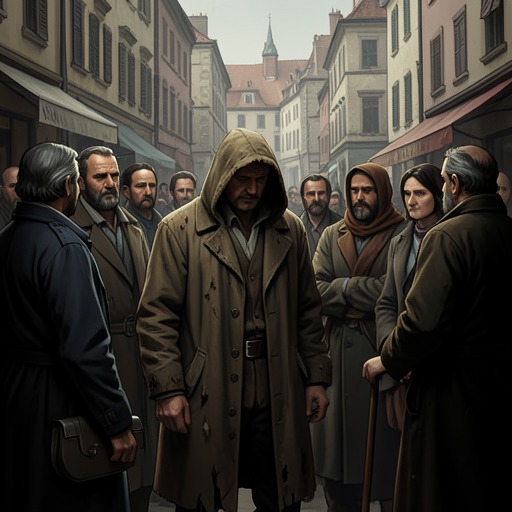
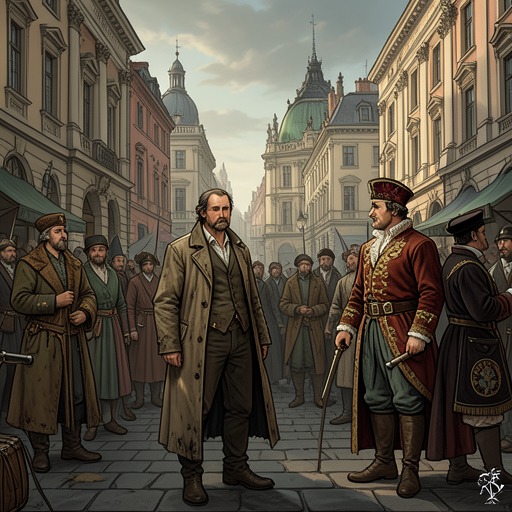
The squire encountered by Lázaro in Toledo makes honra visible in posture, dress, and ritual. He walks with such self-possession that a stranger might take him for a relative of the Count of Arcos, and Lázaro sees how the bearing and decency of his cloak and jacket could persuade onlookers that he has eaten and slept well. The reality is the opposite: the previous day he had eaten only a piece of bread Lázaro had carried in his chest, and, lacking a towel, he dried his hands and face on his jacket. The contrast exposes honour as an appearance that can conceal hunger without relieving it.
The squire’s account of leaving his home in Old Castile makes the code explicit. He says that he departed rather than repeatedly remove his cap before a local knight. Although the knight was richer and of higher standing, the squire resented having been the first to offer the gesture too many times. He explains that a gentleman must preserve his standing and describes avoiding a count who fails to remove his cap sufficiently: on their next meeting, he would enter a house or take another road rather than yield the gesture himself. Rank, in this account, is enacted through minute exchanges of precedence.
His quarrel with a craftsman shows how the same system reaches beyond the nobility. The squire objected when the man greeted him with a blessing that, in his view, treated him like an ordinary person; he demanded the deferential form of address appropriate to his claimed quality. Lázaro questions whether wishing another person well is not good manners. The exchange reveals the code’s dependence on enforced distinctions: even a courteous greeting becomes an affront if it fails to mark the hierarchy the squire expects.
The Squire: Honour Against Material Need
The squire’s status also has a material basis in the privileges and restrictions attached to hidalguía. The narrative’s social portrait describes hidalgos as exempt from taxes but expected to maintain an economic condition adequate to their standing, lest they lose their privileges. They must also be recognizable to those beneath them through their appearance. The squire’s careful clothes and upright bearing perform that public identity, while his claims about property and precedence point to the fragile terms on which it rests.
The sharpest contradiction is economic. The squire is quick to accept the meagre food Lázaro obtains by begging, even as he maintains the bearing of a man entitled to deference. His insistence on honour does not feed either of them; it makes Lázaro’s precarious labour the hidden support for the household’s appearance. The squire is therefore both an object of satire and a pitiable figure: Lázaro recalls his gentleness when he briefly has money and when he comforts the frightened boy, and judges him more compassionately than the blind man or the priest who had means but starved their servant.
Lázaro nevertheless identifies the cost of the squire’s pride. He wishes that his master had been less presumptuous and had lowered his pretensions to match his wretched circumstances. But he also recognizes how fixed the rules seem to be: a man may have no money, yet must keep his cap straight. The squire’s predicament makes the social code look less like an individual vanity than a demand that status remain legible even when the resources that should sustain it have disappeared.
A Reversed Education
The first three masters shape Lázaro’s education in different ways, and the squire is the failed teacher of honra. The blind man directly teaches the boy cunning through their sustained contests; the priest teaches him indirectly by forcing him to devise ways to survive. The squire, by contrast, can offer only the hollow laws of honour associated with reputation and social dignity. Those laws remain alien to Lázaro, who has learned to measure circumstances by hunger, shelter, and the means of getting through the day.
This contrast belongs to the novel’s reversal of conventional exemplary autobiography. The prologue begins in a learned, authoritative register, invoking the pursuit of honour and glory by great men, then turns to a socially humble speaker asked by a superior to explain a consequential case. Lázaro’s life supplies the answer: what appears exemplary from the standpoint of inherited status looks different from the position of someone who must survive its inequalities. His first-person account gives a marginal man authority to expose the difference between official ideals and lived necessity.
Honour, Marriage, and the Ending
At the end, the language of reputation returns around Lázaro’s marriage to the maid of the Archpriest of San Salvador. The archpriest has arranged the match and materially supports the household: he provides grain, meat on religious feast days, bread from the offerings, and his old breeches; he also arranges for the couple to rent a small house nearby. The relationship brings Lázaro security and protection, but also places him within a household whose arrangements invite talk.
The rumors concern Lázaro’s wife going to the archpriest’s house to make his bed or prepare his food. The archpriest tells Lázaro not to heed malicious gossip, assuring him that his wife’s visits are honourable and that he should attend to what benefits him. When Lázaro raises the matter, his wife swears about her reputation, weeps, and curses those who arranged her marriage. Lázaro and the archpriest reassure her; Lázaro promises never to bring it up again and accepts her freedom to come and go by day or night. The three reach an agreement, while the underlying suspicion remains unresolved in the account.
Lázaro then actively polices conversation. He warns anyone who might speak of the matter not to upset him, declares his wife the best woman in Toledo, and says he would fight anyone who claimed otherwise. His emphatic defence sits beside his stated willingness to let the subject rest and his dependence on the archpriest’s support. The ending does not establish the truth of the rumor; it shows instead how Lázaro manages reputation by silencing challenges to the arrangement on which his new security depends.
The narrative dates this prosperity to the year the emperor entered Toledo to hold the Cortes. Lázaro calls it the height of his good fortune, even as the account has shown the terms of that fortune: patronage, a modest household, a socially charged marriage, and a determined refusal to reopen the question. Honra thus binds the squire’s insistence on visible status to Lázaro’s final defence of domestic respectability. In both cases reputation is not separate from material survival; it is a precarious public story that must be maintained, though the squire’s performance leaves him hungry and Lázaro’s leaves the reader aware of what he will not discuss.